Showing posts with label 2008. Show all posts

09/04/2015

Recuerdos de un concierto inolvidable: Jean Michel Jarre (Gran Teatre Liceu 21/04/08 BCN)


Por Antonio Mautor el 25/03/2015

 
Nunca podría haber imaginado ni en mis mejores sueños, presenciar lo que presencié aquella noche de abril en Barcelona. Nada menos que el gran Jean Michel Jarre se presentaba en el Gran Teatre del Liceu para interpretar de manera integra su celebérrimo disco “Oxygene”, en conmemoración a su 30 aniversario; pero no sólo eso era ya de por sí una pasada, lo mejor era saber que lo haría con los mismos instrumentos analógicos que utilizó cuando grabó su obra maestra. La utilización de sintetizadores Theremin, Moog etc… creó una atmósfera, que aún con el paso de los años recuerdo como si fuera aquella noche.

El concierto comenzó de manera sorpresiva apareciendo el artista entre la gente por el patio de butacas, desde donde se dirigió al respetable para hacer una breve introducción de lo que íbamos a presenciar esa noche.

Tras subir al escenario aparecieron sus tres acompañantes, los músicos Francis Rimbert, Dominique Perrier y Claude Samara que se apostaron en sendas islas de sintetizadores, dejando el espacio central para Jarre y sus instrumentos.


Lo que vimos a partir de ahí fue pura magia, sonido analógico pululando por todo el Liceu, acompañado de imágenes y de luces que nos sumergió en otra dimensión en otro mundo. Jarre improvisaba partes de las piezas e incluso las alargaba creando si cabe una sensación de positividad y luz, sólo conseguible por genios como él. Daba la sensación que la intimidad del teatro, hacía que el músico francés se reencontrara consigo mismo como artista, y todo eso nos lo devolvía con luminosidad y ritmo.

Cuando llegó el cénit del concierto, la  pieza “IV” del álbum Jean Michel Jarre miró al respetable, levantó el brazo haciendo una señal dando paso a unas de las composiciones más bellas de la historia.

Cerró la noche con un bis espectacular, tocó sólo  acompañado de dos teclados “Oxygene 13”, demostrándonos que en esas lides es insuperable. El bis a nivel personal me supo a poco, creía que tocaría alguna pieza más, pero no fue así.


Noche para el recuerdo donde de la mano de Jean Michel Jarre, entramos en una máquina del tiempo de donde nunca queríamos regresar. Las sensaciones que me quedaron de esa noche son imborrables, ya le podré decir a mis nietos, que yo estuve allí ese 21 de abril de 2008.


Source: nosgustalamusica.com

19/02/2015

Jean Michel Jarre - Interview Stockholm 2008

Jean Michel Jarre played his Oxygene-concert at The Circus-venue in Stockholm in april 2008.


Source: Lars-Åke Petersson

22/02/2013

Jean-Michel Jarre: "The extraordinary landscapes of the Canary Islands are very inspiring to my music"


14/07/2008
The French musician, pioneer of electronic music, visit observatories of Tenerife and La Palma to prepare for the concert "The Music of the Stars" 


The French composer and performer Jean-Michel Jarre, known worldwide as one of the pioneers of electronic music, has visited the Observatories of Tenerife and La Palma in search of inspiration needed to complete the preparation of the concert "The Music of Stars". This  important cultural event, informative and musical, which will stage the domes of  Roque de los Muchachos Observatory  (La Palma), is part of the activities of the Instituto de Astrofisica de Canarias (IAC) for the next 2009,  along with the inauguration Gran  Telescope Canarias (GTC).

At the request of the International Astronomical Union, 2009 has been declared by UNESCO as "International Year of Astronomy" (IYA2009) and is to commemorate the fourth centenary of the use of the first telescope by  the astronomer Galileo Galilei. In this context, Jean-Michel Jarre has been invited by the IAC astrophysicist. Garik Israelian, a researcher at the IAC and promoter of the concert, to study the Roque de los  Muchachos Observatory and the Teide Observatory  to discuss  the projects production and realisation.

The show aims to link music and astronomy. Israelian believes that "the two go together since the time of Aristotle, since the theory of The Music of the Spheres suggested that celestial bodies emit harmonical sounds. It is time to celebrate this union." The researcher also has the support of Brian May, guitarist of the legendary group Queen and personal friend of Israelian, and also the first of the musicians involved in the project. "You could say that Brian May holds a special place in his heart for the Canaries for many years," says the researcher from the IAC.

Garik Israelian and Brian May recently invited Jean-Michel Jarre to form part of the team to develop the concert "The Music of the Stars" on the island of La Palma. The French musician has joined the initiative with enthusiasm. "The project of Dr. Garik Israelian to approach astrophysics through acoustic astronomy is something that excited me a lot as an artist. I must say that this concept and show linked to Space is a project of a lifetime - my music has often been associated with Space", said the pioneer of electronic music during his first visit a few weeks ago.

Jarre's large outdoor concerts have a singular signature and are renowned worldwide  for their impressive visual impact : he has a unique talent of integrating the landscape or the surrounding architecture into a spectacular scene without infringing upon the nature  of the environment. He deploys state-of-the-art technology in lighting, lasers and  fireworks, with local musicians, orchestras and choirs. He created spectacular events in landscapes accross the planet including  Unesco  World Heritage Sites -  the "Millennium Concert" held in 1999 at the Great Pyramids of Egypt, 
The Forbidden City in Beijing. The skylines of Paris and Houston  have also become scenes for his performances.

In the music of Jean-Michel Jarre, who rose to fame with the international success of his album Oxygene, cosmic sounds reminiscent of ancient stars and planets, have always been present.  In this sense, Jarre has expressed fascination for the lunar Canary landscape. "The visit has been most inspiring for the concert project. The Canary Islands have one of the most extraordinary landscapes in the world. If the Roque de los Muchachos Observatory seemed a pleasant lunar landscape, the Teide and its environs seem to belong to a distant planet". 

"The Music of the Stars is much more than just a show. Our intention is to create a civic event open to everyone, either live, via  television or the Internet," said French musician. Jean Michel Jarre, UN Ambassador for Unesco for over 15 years has been asked by Unesco to be Goodwill Ambassador for the forthcoming IYA2009.

For his part, Brian May states that "we will create something new and  different for this event." After several years away from the stage,  the writer of "We will rock you" and "The show must go on" decided to  resume his studies in astrophysics and obtained his doctorate last  year at Imperial College with a thesis entitled " Radial Velocities in the Zodiacal Dust Cloud. " In July 2007 Dr. May was invested Chancellor of  the University of Liverpool John Moores.


Source: iac.es/divulgacion

21/02/2013

The BBC Insider's Debate - 19/07/2008


A new series of BBC Insiders Debates discusses three topics in depth with those who know most about them.


The Goodwill Ambassadors

At UNESCO headquarters in Paris, Owen Bennett-Jones meets five UNESCO Goodwill Ambassadors - a pop-star, a princess, a space scientist, a global icon and a former prime minister - for a lively and frank discussion about what they do and whether there is any point to their roles.

The participants are musician Jean-Michel Jarre, Princess Firyal of Jordan, scientist Cheick Modibo Diarra, Phan Thi Kim Phuc, who was photographed as a seven-year-old burned by napalm in Vietnam, and the former president of Iceland, Vigdís Finnbogadóttir.  


Source:  bbc.co.uk

radiolistings.co.uk
 

20/02/2013

DiGiCo Supplies Oxygene

February 2008

He’s played live to a record breaking 3.5 million people in Moscow. Two billion people tuned in to see him bring in the new Millennium with the great pyramids as a backdrop. But to celebrate the 30th anniversary of Oxygene, Jean Michel Jarre has gone intimate, and, to help him get the most out of his retro instruments, his Front of House engineer, Alain Courieux, is using a DiGiCo D5 Live digital mixing console.

In November 2007, Jean Michel Jarre released a special anniversary live version of his classic album, Oxygene. The celebration continues this year as Jarre has planned some very special concerts – including the Royal Albert Hall on March 30th – in which he’ll be performing Oxygene in its entirety. The French composer, performer and producer has only ever played excerpts in concert, never the whole piece.

“I decided to do this because when I first recorded Oxygene, I more or less did it in my kitchen - the first ever home studio,” says Jean Michel Jarre. “I was recording on a very, very old eight-track tape recorder at the time. Each time I looked at the machine, I would say to myself that one day I should record this piece of music properly.

“Then, with the evolution of technology and the explosion of high definition for television and audio five years ago, I decided that it was time. I got out the old vintage synthesisers, and was absolutely amazed by the sound and the quality of those instruments that we almost all forgot about somewhere in the Eighties. They have such a special texture, such a special colour. They really are collector items, the equivalent of the Telecaster or the Les Paul Gibson of the Sixties, or the Stradivarius for classic music. They are part of the mythology of electronic music.”

Jean Michel Jarre has decided to put these 50 or 60 crazy instruments on stage and perform Oxygene like it is a futuristic classical concert, but in truly classical venues. These venues are quite unusual for him as they are small, with between 1,000 to 3,000 seats. Very far removed from the millions of people he is used to performing to. “For that, we need a very special sound because these very warm analogue machines are like old ladies, and we need accurate and sophisticated equipment to get the right sound in the unusual venues for this type of music.”

To get this sound, a DiGiCo D5 Live console was chosen. The D5 Live digital mixing system sets a completely new standard for live sound mixing. Its audio quality, convenience, simple and intuitive operation are a world apart from conventional mixing. This complete, self-contained system does away with the need for a multicore, splitters, line drivers, dynamics processors and an entire effects rack.

Alain Courieux, who has more than 30 years experience in live sound engineering, studio recording, sound design and audio consultant, is Jean Michel Jarre’s sound engineer on this tour and a great proponent of DiGiCo consoles. “I used a lot of the internal effects contained in the console,” says Courieux. “So the external effects rack consisted of just a Lexicon 480L reverb and an SSL stereo compressor.”

Virtually every feature is there to see at a glance, or at most a single, logical fingertip press away. The four LCD touch screens present their facilities exactly as you'd expect to find them on an advanced analogue console, with instant access and a refreshing lack of menus to navigate. Packed in to the desk are powerful digital dynamics, an effects package, total recall of every function, a 38x8 output matrix, up to 128 input channel s and 40 multi-configurable internal buses.

“I’m really glad to work with DiGiCo and this fantastic equipment that they provide,” continues Jarre. “I think that the timeless warmth and the texture of the old analogue instruments teamed with the up to date digital sound technology is great. Not only for the PA systems, but also to eventually record the whole piece for film and for live projects. It’s absolutely ideal and we are delighted with it. I’m sure that the D5 is going to perform very well. To match this on stage is my next plan”.

Courieux is looking forward to the rest of the tour that kicks off in March. “ The tour will see us use two DiGiCo D5 consoles, and the monitors and in ear system will be driven with a CS-D5,” Courieux added.


Source: digico.biz

16/02/2013

Futurismo de hace 30 años

Fernando Neira 24 ABR 2008

Jean-Michel Jarre, el martes, en el Palacio de Congresos. / CLAUDIO ÁLVAREZ
Expectación. Ansiedad. Miradas curiosas. El mago de la música electrónica no llegaba esta vez flanqueado por efectos visuales mayestáticos ni exhibiciones de pirotecnia, sino por un arsenal de viejos cacharros analógicos que habrían hecho las delicias del Señor Spock. La escenografía, austera: unos pocos juegos de luces y un gran espejo gigante sobre las cabezas de los oficiantes. Más que un concierto al uso, acontecía un ritual sonoro con el sumo sacerdote y su triunvirato de asistentes accionando teclas, palancas, pulsadores y potenciómetros con el único fin de procurar el éxtasis de la parroquia.

La excusa para esta visita del compositor de Lyón la encontramos en la regrabación de su álbum de cabecera, Oxygène, ahora que se cumplen 30 años desde que media humanidad se imaginara flotando por el espacio al son de aquellos impactantes chisporroteos interestelares. Salvando las muchas distancias estilísticas, a Jarre le ha sucedido algo parecido a lo de Mike Oldfield con su Tubular bells: la sombra de su título referencial es tan alargada que eclipsa toda la producción posterior. Ambos han optado por ponerse en manos de sus departamentos de mercadotecnia y revisitar la obra mítica al cumplirse la tercera década desde su aparición. Es una postura más rentable, sin duda, pero admisible: aunque el nuevo Oxygène apenas aporta un sonido más limpio que el original de 1977, su reescucha supera con creces la siempre implacable prueba del reloj.

La sensación tal vez encaje con los "placeres culpables". Cabría pensar que una partitura tan robótica como la de Oxygène, estirada ahora para el directo hasta los 70 minutos, acumula todos los pecados de aquella precoz fascinación por los artilugios repletos de cables. Podríamos predecir que toda aquella retórica pomposa ha quedado reducida a la condición de yermo anacronismo. Epur si muove. Y pasajes como las partes II y IV o la escandalera del theremín en la parte III conservan un efecto demoledor.

No había más que ver las muchas sonrisas embobadas o el enjambre de grabadoras digitales para comprender que a esta composición le acompaña la buena estrella desde su nacimiento. Estos seis movimientos sintetizados se agigantan en la memoria colectiva de un par de generaciones. La obra magna de Jarre cuenta hasta con el insospechado aval de la premonición: ese emblema de Michel Granger con el planeta Tierra transmutándose en calavera se comprende hoy mucho mejor que cuando casi nadie sabía qué demonios era la capa de ozono.

Source: elpais

25/01/2013

Aerosystem, a Stunning Audio System Designed by Jean Michel Jarre

October 23rd, 2008

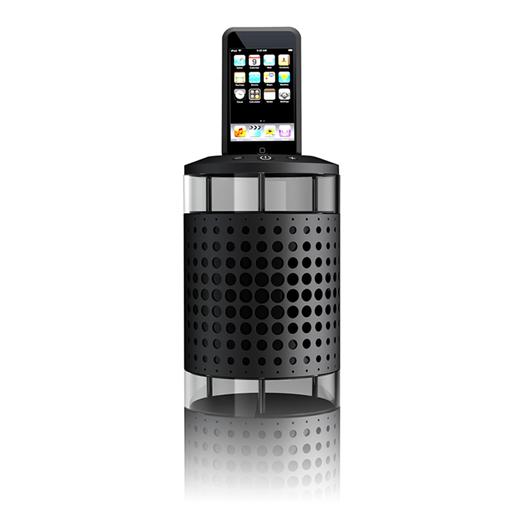
Aerosystem Ipod/iPhone speaker system


I guess there aren't too many among our readers who haven't heard yet of Jean-Michel Jarre, the electronic music guru, one of the artists who have changed the contemporary music in ways few others ever could. JM Jarre's live performances have always involved impressive laser shows and a lot of technology, which was either unknown or unexploited until the French artist brought it in the spotlight; now it's time to welcome his own creation in the field of audio systems: the Aerosystem.

 We’re talking about a loudspeaker system developed by JM Jarre especially for iPods, meaning it can be easily used with iPod 4th generation (color display), iPod 5th generation, iPod mini, iPod nano or the Pod touch.

And of course, if you're on the newest trend in this field and you went for the iPhone 3G, the Aerosystem will gladly accommodate it, as well. Since JM Jarre is well-known for his love for technology, his new design was created from the very start as a spearheading item among similar iPod speakers: boasting advanced manufacturing techniques and materials, it is sworn to deliver a sensational sound, worthy of the finest audiophile ears.

The Aerosystem is a floorstanding loudspeaker system boasting a cylindrical design made from super-strong glass for a non-resonant performance and a solid sound at high volumes. The amplifier has been integrated in the base of the towering structure and it comes with a high-tech sound processor that works hard to restore the highs and lows that have been lost in the MP3 encoding process. While the subwoofer blasts a 45W max RMS power, the midrange and tweeter array adds some more 20W, making the Aerosystem a loudspeaker powerful enough even for rooms larger than your bedroom.


Aerosystem Ipod/iPhone speaker system has neat connectors


Each floorstander takes around 60 days to be fabricated after you order it; even more, you can now choose between several finishes such as black, mirror, Lady (bright pink) and Alien (bright green). You can, of course, use the Aerosystem with pretty much any sound source thanks to the installed 3.5mm stereo Aux In jack; even more, some other audio arrays have been built on it, in 2.1 and 5.1 configurations for the more demanding settings. One such piece of technology, courtesy of Jean-Michel Jarre, retails for around 450 EUR ($575), and if you're looking for more details, you can find them here.
We are just a few, but there are many of you, Softpedia users, out there. That's why we thought it would be a good idea to create an email address for you to help us a little in finding gadgets we missed. Interesting links are bound to be posted with recognition going mainly to those who submit. The address is .

Aerosystem comes with base-integrated amplifier
A nifty remote control for Aerosystem Ipod/iPhone speaker system
Aerosystem Ipod/iPhone speaker system
The 5.1 Aerosystem-based system

Aerosystem Lady Ipod/iPhone speaker system
Aerosystem Alien speaker system

2.1 Aerosystem Ipod/iPhone speaker system

Aerosystem Ocean
 Source: news.softpedia.com

14/01/2013

Jean Michel Jarre revisite Oxygène


Trente ans après avoir révolutionné le monde de la musique contemporaine, le compositeur réenregistre son album mythique...


11 janvier 2008

Photo : Agence France-Presse
Ils étaient tous là, réunis en carré pour l'occasion. Il y avait Eminent 310, Jupiter 8 Roland, Mini Moog et même Thérémine, ce drôle d'instrument d'origine russe. ARP 2600, VCS3, Minipop 7 Drum Machine et Mellotron MK II ne pouvaient pas eux non plus rater cette grande fête, après tout organisée en leur honneur.

Trente ans après avoir révolutionné le monde de la musique contemporaine en lançant, à une époque dominée par le disco et le punk, son désormais mythique album Oxygène, l'artiste français Jean-Michel Jarre vient en effet de rebrancher ses synthétiseurs aux dénominations surannées pour une ultime séance d'enregistrement.

Son objectif est clair: marquer cet anniversaire en cristallisant une nouvelle fois sur CD, à l'aide des technologies d'aujourd'hui, cette symphonie planante qui a marqué les débuts de sa carrière internationale tout en rendant hommage aux instruments analogiques et aux pionniers qui les ont inventés et que le maelström numérique et électronique des dernières années a doucement fait sombrer dans l'oubli.

«C'est un rêve que je caressais depuis longtemps», a indiqué cette semaine au Devoir Jean-Michel Jarre, joint par téléphone à sa résidence parisienne. «En 1977, j'ai enregistré Oxygène dans ma cuisine sur un très vieux magnétophone analogique à huit pistes, mais j'ai toujours eu envie de réenregistrer cette musique un jour, de manière plus professionnelle.»

Motivé par l'explosion récente de la haute définition (autant sonore que visuelle), Jarre est finalement passé aux actes il y a quelques semaines. C'était au studio Alfacam de Lint, en Belgique, où le compositeur a ses habitudes depuis plus d'une décennie. «Je voulais réenregistrer cette oeuvre telle que j'avais envie de l'entendre, ajoute-t-il, avec une profondeur dans le mixage et dans le son qui rend désormais justice à ce que j'avais en tête au départ.»

Baptisé Oxygène - Live In Your Living Room, le résultat rassemble donc sur une galette, que l'Amérique du Nord se prépare à recevoir en guise de voyage dans le temps, les six principaux mouvements de cette ballade musicale de 40 minutes un brin ésotérique qui, en 1977, saluait l'eau, l'air et la planète. Un DVD complète l'exercice de mise à jour en présentant une version en concert, mais sans public, d'Oxygène, avec quatre variations inédites de cette symphonie novatrice qui, au siècle dernier, a été vendue à travers le monde à pas moins de 12 millions d'exemplaires.

«Ce n'était pas joué d'avance», se souvient le fils de Maurice Jarre, célèbre compositeur de musique de films. «Beaucoup de maisons de disque avaient refusé Oxygène parce qu'il n'y avait pas de chanteur. Pire, les morceaux ne portaient pas de nom [l'oeuvre se décline en sections numérotées de 1 à 6] et, contrairement à la pop, certains mouvements duraient dix minutes.»

Le pari était audacieux. Il plaçait aussi cet objet sonore non identifié à des années-lumière non seulement des courants musicaux de l'époque mais aussi de l'électronique glaciale et industrielle du groupe Kraftwerk, pionnier dans ce domaine qui sévissait en Allemagne lors de cette même décennie 70.

Des thèmes qui traversent le temps

Avec sa poésie futuriste et ses sonorités atypiques, l'oeuvre ne décape pas. Mais elle séduit. Et elle peut encore le faire aujourd'hui, croit Jean-Michel Jarre qui, sans surprise, en fin calculateur et programmateur qu'il est, reconnaît le caractère «intemporel» de sa symphonie.

«C'est la chose qui m'a frappé quand j'ai commencé à reprendre l'enregistrement, dit-il. Cette musique, ces sons ne sont pas figés dans le temps. Ils sont même très d'actualité.» Normal, selon lui. «Ma musique n'a jamais été liée à la science-fiction mais plutôt à la biosphère et à la stratosphère, ajoute-t-il. Or le thème d'Oxygène, c'est quoi? L'environnement et l'écologie, des préoccupations très lyriques il y a 30 ans qui sont devenues de plus en plus sérieuses aujourd'hui. Tellement que la pochette de cet album [un crâne humain sortant de la Terre en la déchirant] pourrait facilement être le logo d'Al Gore [l'ancien vice-président américain devenu environnementaliste].»

Conséquence: dans un monde (aujourd'hui le nôtre) «plus sombre» et où l'avenir que nous avons fantasmé dans les années 70 est maintenant «derrière nous», Oxygène offrirait donc un bol d'air aussi frais que rassurant, croit Jarre, avec «le grain unique» que donnent à cette oeuvre tous les instruments analogiques du passé qu'il a utilisés.

«C'est un retour aux sources, dit-il. Je ne pouvais pas envisager de prendre des instruments numériques puisque Oxygène n'a pas été écrit pour cette technologie. Et c'est très bien comme ça. Ces instruments font partie de la mythologie de la musique électronique. C'est l'équivalent des stradivarius pour la musique classique. Ils sont tellement mythiques que les instruments numériques s'inspirent d'ailleurs de leur ergonomie mais n'arrivent pas à reproduire leur grain et leur jeu. Quant aux musiciens d'aujourd'hui, beaucoup rêveraient d'en jouer.» Mais le fantasme est forcément inassouvi puisque ces instruments analogiques ne sont plus fabriqués depuis le début des années 80.

«Dans le monde de l'électronique, nous sommes orphelins de nos racines, poursuit Jarre. Et pourtant, quand on parle de la musique électronique, on ne peut pas ignorer ses fondations.»

Racines retrouvées

En faisant entrer Oxygène dans l'air du temps, c'est donc aussi à un travail de reconstruction de la mémoire collective que l'artiste s'adonnerait. Et ce, sans pour autant se placer au centre de cette reconstruction, comme pourraient le laisser présager ses nombreuses apparitions, forcément narcissiques, dans les pages des magazines «pipole», comme disent les Français. Jarre avait en effet été élu personnalité de l'année par le magazine People, l'année d'Oxygène, justement.

«Le grand oublié, c'est Pierre Shaeffer [fondateur du Groupe de recherches musicales (GRM) où Jarre, tout comme le grand Karlheinz Stockhausen, a fait ses premières armes et est entré en contact avec l'AKS, le Thérémine et le Digisequencer]. C'est à lui que je dédie Oxygène», lance le compositeur. «Pierre Shaeffer, c'est une des figures les plus importantes de la musique du XXe siècle. Il a changé la manière de penser la musique en étant le premier à dire qu'elle n'était pas seulement faite de notes mais aussi de sons et que la différence entre un son et un bruit, c'est le geste du musicien. C'est lui qui a inventé le design sonore, l'échantillonnage, le réverbéromètre. Tous les procédés de composition actuels ont été inventés par Shaeffer dans les années 40. Sans lui, je ne serais pas là aujourd'hui.»

L'élève est reconnaissant. Il espère aussi transporter sa reconnaissance sur la scène de plusieurs salles de spectacles européennes où, au cours des prochaines semaines, une version live et intimiste d'Oxygène doit être présentée après une série de dix concerts qui viennent de se conclure au théâtre Marigny-Robert-Hossein à Paris, minuscule théâtre à l'italienne qui tranche avec les concerts à grand déploiement dont Jean-Michel Jarre s'est fait le chantre, notamment à la cité interdite de Pékin, aux pyramides de Gizeh, sur le site de la NASA à Houston et sur la place de la Concorde à Paris.

«Le format d'Oxygène justifie cette intimité», justifie-t-il lorsqu'on le place devant ce paradoxe. «Mais j'ai toujours pensé que la musique électronique résonnait mieux à l'extérieur qu'à l'intérieur. Et puis, l'idée du partage d'une rencontre singulière où ni le public ni vous n'avez de deuxième chance m'a toujours inspiré.»

Tout en faisant rayonner Jarre à travers le monde, cette quête du concert plus grand que nature, qui lui vaut aussi une image d'artiste nouvel-âge et un chouïa ringard, n'est d'ailleurs pas sa seule source d'inspiration, à en croire l'artiste, dont le présent bain d'Oxygène semble finalement très profitable. Sur le plan créatif, s'entend.

«Ce retour aux sources m'a permis de faire mon auto-analyse, dit-il. Au cours des dernières années, la technologie nous a poussés vers le numérique, avec lequel il est possible de faire de belles choses. Mais en découpant le son avec des zéros et des uns [les codes binaires], on arrive, sur le plan psychoacoustique, à une différence significative par rapport à l'analogique. C'est la même différence qu'entre une femme qui est maquillée et une femme qui est coupée en morceaux. Et en revisitant Oxygène, je me suis dit que je préfère les femmes maquillées.»

La suite est donc prévisible. «J'ai revu mes projets d'albums, poursuit Jean-Michel Jarre. J'ai envie de retravailler avec des instruments analogiques pour leur sensualité et la grande poésie qu'ils permettent de générer.» Au grand bonheur du Taurus Moog, du Ribbon Controller Doepper et du RMI Harmonic Synthesizer qui, après la fête, ne seront peut-être pas remisés de sitôt.

Source: edevoir.com/culture/musique

08/12/2012

The keys to my success: Jean Michel Jarre


12 January 2008

Jean Michel Jarre recently celebrated the 30th anniversary of his best-known work, the 12 million-selling Oxygène, with a ten-night run at the Théâtre Marigny in Paris.

The album, consisting entirely of electronic instrumental music, recorded at Jarre's home, was the surprise hit of 1977, producing a memorable single, Oxygène (Part IV).

In Paris last December, Jarre performed the entire work using the original equipment, including more than 50 vintage synthesizers, and he is due to bring the show to London's Royal Albert Hall this March.


It will be a relatively intimate event for Jarre, who is better known for huge, globe-straddling multimedia events.

The first was before a million people in Place de la Concorde in Paris, in 1979. The most recent was the Water For Life concert in the Sahara in 2006. Then there have been historic one-night stopovers such as the Eiffel Tower, the Pyramids, the Acropolis and Tiananmen Square.

The 59-year-old French composer has had four entries in the Guinness Book Of Records for concert attendances, breaking his own total three times ? the largest being in 1997 when he performed to 3.5 million people in Moscow.

Jarre was married for 20 years to the English actress, Charlotte Rampling, before they divorced in 1998.

They have one son, David Jarre, an internationally renowned magician.


Oxygène was turned down by all the record companies. 

It was like a UFO ? it was made in the middle of the disco and punk eras and the record companies said, "What is it? No singer, no proper song titles? And, on top of that, it's French!" Even my mum asked, "Why are you giving your music the name of a gas?" Yet people talk of Oxygène now as my "masterpiece". When it became such a success, it was strange ? a very exciting period and kind of innocent. You find you have a lot of new friends around you and it's almost as if they want the success to continue more than you do.

Making my music is like being a chef


It's no coincidence that Oxygène was recorded in my kitchen in Paris.I had to find the right ingredients, bringing everything to the right temperature. don't like the preconceived idea about electronic music that it is cold, futuristic or robotic. I want my music to sound warm, human and organic. I'm not a scientist working in a laboratory ? I'm more like a painter, Jackson Pollock for example, mixing colour and light, experimenting with textures.

I'm really playing those instruments: I don't just click a mouse and sit back. 


They are not fake instruments. The beauty is that you can create the sound of the Moon, the sound of light. Nothing is repeated. It's music that breathes.

To me, the original VCS3 synthesizer is like a Stradivarius


All these old analogue instruments are very poetic.I have a huge emotional relationship with them. My first synthesizer was the VCS3. I got it in Bristol in the late Sixties, long before Pink Floyd used them. I had to sell an acoustic guitar and an old reel-to-reel tape recorder to raise the money. You can do fantastic things with modern computers but you cannot use them in the same intuitive, spontaneous way you can a VCS3. You also have the Minimoog, which is very famous, and a Dutch invention called the Eminent, which was patented in the late Sixties. The sound of Oxygène is based on the fantastic string effects of the Eminent.

To play some of these old instruments you need the Force to be with you.


The theramin, for example ? it's totally intuitive. It looks like a Thirties radio with two antennae ? just by moving your hands towards the antennae you control the volume and the pitch, producing this fantastic sound like a soprano vocal. Stravinsky used one, as did the Beach Boys on Good Vibrations. It's very tricky to play.

 I own some of the world's most unusual synthesizers. 

They include the ARP 2600, a huge modular synthesizer. That's the instrument Pete Townshend created The Who's Baba O'Riley on. There are only about 30 left.

Back in the Seventies we had a romantic, poetic vision of the future, like it was in the movie 2001: A Space Odyssey. 


It felt as if everything was still ahead of us. Today, it is all behind us. That is not to say that my music is attached to sci-fi. I see my music as more attached to the biosphere than the stratosphere.

I collect robots. 


They're mainly Japanese, American and especially Russian ? small robots, big robots and old toy robots made between 1910 and the Fifties. That period was all about futurism, from the art of Kandinsky to crazy guys building strange robots and sci-fi creatures, utopian-type things. In those days there were lots of dreamers about the future.I got into all that.

Going to the US or China and hearing your music on the radio is like signing your soul to the devil. 


You can start to lose your own identity when your image becomes bigger than who you actually are. There are so many temptations, so many excesses, it can kill you. America is the worst. I was voted People magazine's Man Of The Year in the Seventies, and the women? well, you have to be clear in your mind what these things mean or your brain will implode.

Pope John Paul II had big feet. 


The first thing I noticed when I met him was the size of his shoes. I thought to myself, "My God, this man has his head in the sky but his feet solidly on the ground."

I'll never forget the day of Princess Diana's funeral. 


We had been quite close friends, and on that day I was doing a concert in Moscow for 3.5 million people. I knew she was keen on one song I'd written called Souvenir Of China. So I decided to dedicate it to her and ask the audience for a minute's silence. You can imagine the scene in Moscow with more than three million noisy people, the amount of vodka, craziness everywhere? But the entire city remained silent. It was so moving that everyone started crying. The tears were running down my face so much I couldn't even start to play again. Even now, just talking about it makes me emotional.

Why do I play these big events? 


First, it's the fact that electronic instruments are not really made for live performance, so long tours are not feasible. And I became inspired by Italian opera, working with carpenters, painters, costumiers and, in my case, video artists, light-show specialists and architects. Also, because I've always considered my music to be attached to the immediate environment, I wanted to perform outdoors, to hijack one whole place for a night ? something where, as an artist, you have no second chance. At the Place de la Concorde [in 1979], one guy came up afterwards ? he had a long beard like Fidel Castro's ? and he said, "I've never seen anything like that before in my life." I thanked him and someone said, "Do you know who that was? Mick Jagger"

My favourite concert nearly didn't happen. 


I thought it was a joke when Lech Walesa phoned me to play at Gdansk in 2005. I just didn't believe him. The concert was a kind of Blade Runner experience because it was in exactly that spot that the world had changed, leading to the eventual collapse of the Soviet system.

Arthur C Clarke thought aliens would respond to my music. 


He told me, "We must do something in outer space ? perhaps a concert on the Moon." He thought it would be a good point of contact.

My favourite thing to spend money on used to be cars ? especially old British and American ones.  


I had a Bugatti, which I bought in England, an old XJ140 Jaguar and a Cadillac Eldorado, which I bought in the US. I had cars all over the world. I drove them all, including the Bugatti. I was keener, though, on the XJ140 and the Cadillac. I'd put the family in them and off we'd go. Of course, you had to stop from garage to garage, because they kept breaking down, but I didn't care.

Oxygène made me rich ? but not as rich as you might think


 Back then managers and record companies were getting too much money. Having said that, I was able to buy a large house in Paris where I built my own studio, plus a house in London.

It has been very moving playing Oxygène again. 


 In Paris I was playing to small audiences of only about 500. I love using all the old equipment.

It's been quite an experience.

                 "Oxygène: Live In Your Living Room", the 30th anniversary


Source: dailymail

Jean Michel Jarre - Documentary

 Paroles et Musique 2008

Documentaire produit par Jean-Louis Remilleux, réalisé par Benjamin Roussel qui fait suite à la tournée Oxygène de 2008, qui brosse un portrait de Jean Michel Jarre depuis ses débuts.


Jean Michel Jarre - "Making The Steamroller Fly" (from DVD Oxygene Moscow (1997)
  
"Making The Steamroller Fly" (53 min.), a documentary by acclaimed director Aubrey Powell who sets out to discover the man behind the legend on the eve of Jarre's greatest live spectacular.
Documentary , which features interviews with Jarre and his "tribe" discussing the music and the concerts. For fans this is a chance to see footage of Jarre's earlier concerts in Paris, China, Houston, and Lyon as well as insights into a 20-year history of electronic music and mega-concerts.


04/12/2012

Jean Michel Jarre - Interviews (Radio)


Interview Norwegian Radio NRK P3 Lydverket - 23 April 2008 

  
Interview FM Dutch Radio 2 Hans Schiffers - 21.09. 2004


Interview Belgium RTBF Radio - 13.09.2004


Interview in the Steve Wright Show BBC Radio 2 (10.09.2004) 


Interview in BBC Radio1 Simon Bates (12.08.1993) 

13/11/2012

Jean Michel Jarre - Interview Sound On Sound Feb 2008

By Tom Flint

To celebrate the 30th anniversary of his hugely influential hit album Oxygene, Jean Michel Jarre has produced an audacious DVD performance of the entire piece in a manner never before attempted.

If anyone can lay claim to having raised the popularity of instrumental electronic music to the level of stadium rock it is Jean Michel Jarre, renowned for spectacular live shows featuring lasers, fireworks and other unforgettable visuals. As well as selling more than 60 million records worldwide over the last 30 years, the Frenchman has made it into the Guinness Book Of World Records, on three separate occasions, by attracting huge concert audiences, the most recent comprising 3.5 million people.
There have been many other historic milestones in Jarre’s career. He was, for example, the first composer to introduce electro-acoustic music into the Paris Opera House and the first Western musician to tour China. From a technological perspective, he has also been at the forefront of new developments. He was among the first to embrace the 5.1 medium with his album Aero, and his latest DVD, Live In Your Living Room, is the first release to use a new breed of 3D technology developed for the latest home-theatre cinema systems.

Small Beginnings

JMJ is undoubtedly a great showman, entertaining millions with state-of-the-art stage theatrics, but before becoming a household name, he spent many years creating experimental electronic music using tape-loop effects and some of the first analogue synthesizers, for a time under the guidance of the visionary French composer Pierre Schaeffer. By 1977, Jarre already had a couple of albums and a film soundtrack under his belt, but it was the reception received that year by Oxygene that was responsible for his ascent to international stardom. The LP’s success was remarkable, given that it is a fairly minimal instrumental concept album recorded on a tiny budget in not much more than a well-equipped home studio.
“I really did it in a kind of home way using what, I think, was one of the first home studios,” Jarre reflects. “I just had three or four synthesizers and was using a Scully eight-track and a mixture of Ampex 256 and 3M tape. The whole album was done on just one eight-track and you can hear that in the piece - it’s quite minimalist and I think that contributes to its timelessness.” Remarkably, the album went on to sell an estimated 12 million copies and produced the instantly memorable ‘Oxygene IV’, one of electronic instrumental music’s most iconic themes.
So why re-record the classic, rather than simply re-release it for its anniversary? Surprisingly, the idea has been on Jean Michel’s mind almost since day one. “Actually, I got this idea to re-record the album very early after I recorded it because, although I was OK with the music, I always thought that I could have had better conditions for the recording process. It has nothing to do with analogue versus digital: even analogue-wise I thought that I could have better preamps and things like that. When the digital era exploded at the beginning of the ’80s I said ‘OK, I’ll do that one day,’ but for me digital was, for quite a while, not as good as the analogue processing by a long way, and it’s only quite recently - I would say in the last five years - that with 96kHz, 192kHz, and 24-bit, we’ve entered what we can call the high-definition era. And only since then I decided to take the opportunity of the 30th anniversary to do a better recording.”
Jean Michel’s plan was to follow as closely as possible the original recording process, using the same synths and effects wherever possible, but replacing the Scully eight-track with a Mac-based Pro Tools HD3 system, recording at 24-bit, 96KHz via a Summit Audio TPA 200B Dual Tube preamp and Neve and API processors. “I put almost everything through the Summit,” he says, “and I got this good, fat, analogue sound. I also used an old Neve preamp and an API, just to put it on Pro Tools, basically. When I mixed, I used only digital processing because I realised that having analogue sources is what really counts. When you have all analogue synthesizers and you put that in Pro Tools at 96KHz, 24-bit, it is almost transparent. The main difference is when you are using virtual instruments - when everything in the chain is digital - that’s definitely totally different.”

The massive live area-cum-store-room in Jarre’s Paris studio, with synths set up as they were for the performance of Oxygene on the Live In Your Living Room DVD.The original was also recorded without the aid of a sync track or timecode, and pre-dated MIDI sequencing, so Jean Michel elected not to use these tools for the remake either. “I played and triggered all the sequences by hand,” he continues. “With sequencers you are working with patterns and blocks, so it was very interesting revisiting songs and realising that the process of not working with patterns is a totally different journey - a totally different trip, really. I remembered that when I started to do electronic music I was obsessed - I more or less forgot that obsession along the way - about not having anything being repeated in exactly the same way. For me it was exactly the opposite attitude to that of Kraftwerk, Tangerine Dream and all those electronic bands who were doing something more robotic. I considered electronic music in a much more sensual, organic way, where nothing should be repeated.
“So, on Oxygene nothing is repeated the same way. Each sound, even if appears to be the same, has a slightly different attack and release, and, as the sequences are being made by hand, by definition they are not exactly the same. Even the sounds of the drum machines were filtered in a very subtle way to give life inside the patterns.

Two Revox B77 tape machines used for delays were, says Jarre, responsible for “40 to 50 percent” of the sound of the re-recorded Oxygene.“I used a lot of pedals like the Electro-Harmonix Small Stone phase shifter to create the modulations and delays, and for the remake I had a pair of Revox B77s for tape delays. Actually, I would say that 40 or 50 percent of the music is coming from the Revox machines, because I was quite extreme, by having a signal direct on one side and delay on the other, almost at the same percentage.”

Making It Live

Through the process of making the new Oxygene recording, which involved dusting down many of his old vintage synthesizers, Jean Michel began to consider the idea of actually performing the whole album live from start to finish, something he had never done before for logistical reasons. The idea led eventually to the production of the Live In Your Living Room DVD, which is actually a studio recording, but performed live in front of cameras instead of an audience. The performance will be of great interest to all synth enthusiasts, not only Jarre fans, for it acts as a fabulous demonstration of the world’s most sought-after analogue synthesizers being played in a genuine live situation.
Jean Michel explains how the idea evolved. “I have often played excerpts from Oxygene, but never the entire piece. These days, as we know, so many concerts are pre-recorded or pre-produced to diminish the risk of mistakes and optimise the result, but I decided to perform the whole piece in a real, live situation with no computers. So we put everything in a big warehouse and filmed the performance without any stops. The DVD is not made up of a few takes - it’s like a concert film, except the idea is the audience is the people watching on their plasma-screen TV or whatever.”
One thing Jean Michel really wanted to do was make sure that the same instruments were used as on the original album, even though there was the possibility of using more reliable modern equivalents. To complicate matters, Oxygene was an eight-track recording, featuring as many independent synth lines playing together. Having just two hands and no multitimbrality or sequencers meant that a live performance required three other musicians and extra banks of vintage synthesizers. Drafted in to provide the other six hands were Jarre’s long-time collaborators Dominique Perrier, Claude Samard and Francis Rimbert.
“Sometimes there are two or three layers of the same sound, each with different phasing and processing,” explains Jean Michel. “For example, there are several Eminent String Machines that make up one of the main Oxygene string sounds. Having four of us meant I had to multiply the number of instruments, and finding the equipment was quite a headache, especially as I tried, as much as I could, to avoid using instruments produced after Oxygene. There are one or two exceptions but 95 percent of the instruments are of that time. For me it was really important for the radicalism of the process.”

EMS VCS3 and Synthi AKS pin-matrix modular synths were central to the recreation of Oxygene; no fewer than five are visible in the pictures of Jarre’s studio.Most abundant in the setup are the EMS Synthi AKS and VCS3 synthesizers, each one set up with a certain variety of patch, as Jean Michel explains. “During the piece you have the VCS3 or AKS being used for lots of different sounds, but because they have no presets it takes too long to change between numbers, so we have four or five on stage and each synth is used for one family, style or range of sounds.”
Having so recently re-recorded the album, Jean Michel was well aware of what he’d used for each part, but he still needed to plan the setup in a way that would enable four people to perform the piece together. “At first I had to see who was doing what per song,” he explains. “It was more or less like a band situation where someone says ‘OK, I have a good feeling for that part, I’ll take care of it.’ That’s also a reason why we have some repetition in terms of gear. Then I could say ‘OK, for this number this person will need this, this and this, for the second, this, this and this.’ I planned it by drawing it on paper and then everything went together like Lego!”
Remarkably, Jean Michel reckons that rehearsing the album to a point where it was ready to perform in one take only took about two weeks, although he was under a little bit of pressure to meet the important anniversary deadline. “Everything went so fast because I changed record companies this year, partly for this type of project. After that everything has had to be done with a kind of emergency feeling, but that seems to fit the project so I love that.”

Camera Action

For the filming, the four musician were arranged in a ‘T’ shape (Perrier far left, Rimbert on the right, Jarre out in front and Samard in the middle) within the warehouse, so that each person was surrounded on four sides by his bank of instruments. On stands facing the four, and fed by the Mackie FOH desk, were two large Genelec PA monitors, ensuring everyone was listening to the same thing. Two microphones were placed pointing outwards from the front of the setup to capture the ambience of the warehouse. The synthesizer outputs were recorded into Pro Tools on separate tracks.
Finally, a large corridor of space was left around the perimeter of the setup for the camera operators, enabling them to capture the action from all angles. Antwerp-based Alfacam, specialists in high-definition TV filming, were hired to shoot the DVD, having previously worked on Jean Michel’s Beijing concert in 2004. “They are really nice people who are technically very precise,” comments Jarre. “We rehear.sed the performance choreographically, to avoid a situation where one camera man would get in the way of the lens of the other.
“On top of that, I decided to produce a 3D Stereoscopic version. I thought the idea was quite interesting because 3D is retro-futuristic stuff; it reminds us of the 1950s when you have these guys wearing white glasses and all that. I’m quite familiar with the idea because about 10 years ago I worked with Apple filming a concert in 3D. It’s going to be the next step in the entertainment world. James Cameron has developed a new Stereoscopic movie camera and 3D projectors have been installed in 1000 theatres in the US. Actually, the 3D version is going to be released in 50 theatres in Germany and the US.
“For filming you have two lenses for each camera, so you produce separate HD masters for each eye. The lenses are spaced the width of the eyes, and you have to do some pretty precise, boring stuff to get the right angles depending on where you want the focus, but the result is spectacular. With standard home DVD players and screens, the only way to get 3D at the moment is by using the old red and blue glasses, but Phillips is developing a new screen you can use without glasses. Our film is ready for that but it’s still a prototype. I think it’s very interesting, because until now music was the only mode of expression invading the space around us.”
Of course, the Stereoscopic visuals go hand in hand with surround sound, and JMJ is no stranger to the format. “I’ve worked a lot on 5.1 since Aero,” he adds. “That was really the first album, I think, conceived and produced especially for 5.1. It’s got the THX label and George Lucas is using it for THX demonstrations.
“I’m not looking for realism; I’m looking for musical results, and I think what’s great about electronic music is that you don’t care if you are in the middle of this orchestra. You don’t know which instrument is doing what, so having them in front of you and the audience behind seems, to me, a bit irrelevant in that case. It’s much more fun and exciting to be in the middle of all these sounds going around. In that aspect, electronic music is made for 5.1 more than anything else.”

The Performance

Some of the desirable modular and semi-modular synths used on both the original and the recreated Oxygene. From top left, clockwise: Korg PS3200, ARP 2500, ARP 2600 (two were used) and Moog modular. Although Live In Your Living Room runs through the Oxygene tracks chronologically, it also offers listeners three extra tracks not found on either the original or remake. As the performance is a continuous piece of music, the new sections form links between the main movements. Jean Michel explains how the transition parts came about. “I suddenly realised that to get from one part to another in a more live situation it would be nice for the other musicians to be in a freer, improvised thinking pattern. So we’ve either improvised variations between different songs, or lengthened the existing parts. When I started feeling that it was the right time to change, I began introducing the next part and everybody followed. It happened in a rather natural way but we also used eye contact to communicate.”
In contrast to the free-form transitional parts, a notated orchestral score was used by all the musicians to help them with the rest of the material. “It’s one thing when you are all by yourself, overdubbing one bit at a time because you know what you’ve just played,” explains Jean Michel, “but when you’re playing all the parts at the same time, particularly when you don’t have a drum machine, you need to have a method of counting the measures to be able to play together. So, it was strange, but fun, using this kind of retro-futuristic system that mixed a quite serious orchestral score with a performance on analogue electronic instruments!”
Although the performance was undertaken without any click, MIDI or time reference, there were still some electronic drum parts, emanating from two Keio Mini Pops drum machines, which occasionally had to be started so that they fell in time with the pre-established tempo. Claude Samard, positioned in the middle of the other three musicians, was the official musical director of the project, given the task of operating the Mini Pops and other critical rhythmical parts. To help him start the drum machine in the right place, Jean Michel, or one of the other musicians, would introduce a sound that acted as a signal for everyone. “For ‘Oxygene IV’ he was getting this kind of crescendo of noise,” explains Jean Michel, “and was just counting one, two, three, four, hitting Play and we were all right in time, hopefully well, almost! The Mini Pops has no in or output sync, so you have to play everything around it, even the song’s bass sequence. It’s a bit of a problem playing like a human sequencer.”
Although separate feeds were taken into the Pro Tools system from all the synthesizers, so that they could be mixed at a later date, it was always the intention not to change much afterwards. “We all know that for a lot of live releases you end up redoing everything in the studio,” says Jarre, “but for this particular experience that would have been silly, so the idea was to keep all the accidents - even if you have the wrong note being played, or something not really in tune - to keep the whole thing and therefore the truth and authenticity of the performance.
“The only thing I changed is the delays, and that was only because I didn’t want to carry my Revox machines to the warehouse. I was just in the middle of finishing the mix of the studio version; I didn’t want to change anything, and when you are travelling with those kinds of things, you never know if something will happen. So, just to be sure, I used some regular delays for the performance and later exchanged them for the Revox machines. But what has been played has been kept.
“For both the album and live recording I didn’t work with stereo sources at all apart from mono-to-stereo reverb, just to give it a sense of space. Otherwise, all delays and sources are mono. Obviously, when you work in 5.1, stereo is a headache, so you have to be in mono.”
In terms of processing, the Summit Audio preamps favoured for the album recording were not used live, only the direct feeds routed via the front of house desk. However, Jean Michel is insistent that the raw synthesizer outputs were perfectly good enough. “I was totally amazed, as were the sound engineers, by the warmth and depth of the sound when you have all this analogue stuff on stage playing together. Nothing is harsh, so you can push up the volume and you have no aggressiveness; it’s amazing how very round, warm, solid and fat the sound can be. And all these sounds mix, so you never get those kind of digital phase problems or foggy type of effect. With all those instruments playing on stage it’s like a symphonic orchestra, where you have violins mixing with trumpets and they all really work together. I’ve never experienced that before, so it was really amazing to mix a Mellotron with a modular Moog, analogue drum machines, Eminent strings, AKSs and all that.”

Happy Accidents

One of Jean Michel’s main reasons for using the old analogue gear, despite its quirks and issues of reliability, was to engineer a situation in which the band were forced to react in a musical way to any random mistakes or accidents that occurred. One issue thrown up by the relative tuning of the Eminent String Ensembles proved to be particularly beneficial.
“The Eminents were not tuned to exactly the same pitch, and we had an instrument where the pitch was blocked so we couldn’t change it. It made us realise that nowadays everything is automatically at 440, 442. We detune, but we do big important detuning as an effect. The sort of subtle detunes that you have in acoustic instruments are found less and less with electronic instruments, where the tuning is done somewhere in a digital patch. The stuck pitch was around 443 or something like that, so it gave us something strange. It was one of those scary, silent movie soundtrack-type sounds that reinforced the atmosphere.
“Also, in the keyboard of the ARP 2600 there are two notes that make the synth go berserk each time you play them. That created some interesting things when we did a chorus or improvised. We had a few accidents with that so we built everything around the accidents, making other instruments respond with strange sounds.
“Obviously it’s a risky situation to go on stage with those instruments because they are not reliable like a Mac, but at the same time it is also that kind of risk when suddenly you have an accident that can give you something else. In electronic music these days, where everything is so pre-produced and clean to optimise the result, we are killing the effect of surprise. We have rock bands with just guitar, drums and bass coming back instead of keyboards and synthesizers, because of this reason. People are bored of being behind their computer and want to express themselves with a rawer attitude, and with those analogue instruments you are in exactly the situation of a rock band, where you just plug and play.”

The Future Now

Now that Jean Michel has revived his love of old synths, he is adamant that he will continue using them on future projects, and he has some strong views on the pros and cons of today’s music technology. “By playing with real analogue stuff, you realise how unique these instruments are. All the musicians and engineers working with me said the same thing. Those instruments are incredibly rich - no one can beat that. We have fantastic virtual synthesizers and emulations of vintage instruments, and you can do lots of interesting music with the technology, but they are so different you cannot compare them - just forget it! You can’t compare a 400-kilo Mellotron with a virtual synth that’s imitating the look of it. It has almost nothing in common. Oxygene could only have been done with the old analogue instruments; that was part of the experience, and now I want to experiment more with them.
“New bands today want Fender Stratocasters or Les Paul Gibsons from the early ’60s because they have a different sound, but it’s not a retro attitude, because if you take, for instance, a symphony orchestra violin player, his dream is to play a Stradivarius, made in the 17th century. It shows that with all the technology we have, no one has been able to make an instrument of that quality. It proves that building great instruments it is not just based on how technologically advanced or sophisticated you are.
“What’s really interesting is that we haven’t invented many new instruments. We have much more sophisticated ways of processing sounds or emulating frequencies, but the irony is that virtual instruments are all about recreating the past, right down to the look of the interface. But then you find yourself playing in a rather awkward way with your mouse or remote control! This is instead of getting back to the real instruments, which is a totally different approach, where you have a large facade with knobs that you can instantly grab and alter and you can be constantly processing the sounds and getting instant feedback from the machine.
“In principle you can do all that with a computer - but you don’t, because you memorise everything. But with these instruments, aside from the Memorymoog, you have no presets. These ephemeral situations, in which you are all the time, put you in a totally different frame of mind. It’s like when you are in front of a guitar - you don’t preset your chords or sounds, it’s a dialogue with your instrument. That physical response is something we have forgotten, and yet it’s the foundation of rock & roll. It is based on intuition and doing music with your instinct, not only with your brain.
“Looking back, the 1980s was a really dark time for me. The ’90s were better and this decade is definitely far better, but back in the ’80s we were at the beginning of the digital age. Even if it was a revolution, it broke an old poetic attitude towards electronic music. Suddenly everything worked in terms of patterns and presets, and we all became archivists for quite a while, instead of having this kind of artisan, craftsperson attitude and an intuitive relationship with our instruments. I think we all fall into that trap. It’s not better or worse, it’s just something different.
“And the designers even stopped producing those instruments. Tom Oberheim, Bob Moog - they all more or less stopped. And crazy guys like Mike Matthews, doing all the Electro-Harmonix Electric Mistress flanger and Small Stone phaser pedals. They are absolutely amazing; you can’t get those sounds with virtual effects. Those instruments are part of the mythology of electronic music at the same level as the Stradivarius, Steinway, Gibson Les Paul or Fender Telecaster. A lot of people have only seen these synthesizers in photos so it’s a good opportunity to show everybody in the world of music - and the audience in general - that they should be considered at the same level as Stradivarius. You have this mythology in rock & roll, obviously you have it in classical music and jazz, but, apart from Moog who more or less everybody has heard about, the other synthesizers are relatively unknown.
“This whole thing is a tribute to all those guys who created these instruments, without whom I wouldn’t be there, you wouldn’t be there and most of the people wouldn’t be there!”

Inside The Studio

Jean Michel Jarre’s studio, on the outskirts of Paris, is pretty much under construction at the moment, but is all the more interesting for that, as it reveals so much about where he has come from and where he is going. The control room is the one completed area so far, and is suitably soundproofed, decorated and furnished. Here there is a Mackie Control 24 desk acting as the front end for the Pro Tools HD3 rig, running on a Mac G5, a large screen for monitoring DVD images and viewing the Pro Tools interface, plus a few racks of processors housing, amongst other things, his prized Revox B77 tape machines.

Elsewhere in the building is a larger performance/store room which can only be described as extremely rustic, with patched-up walls and a vaulted brick ceiling shored up by steel girders. Although some plasterboard has been thrown up here and there, the room is still very much the store area it no doubt was 150 years ago, and, as such, is packed to the vaults with flightcases, boxes and shelves containing miscellaneous gear gathered throughout Jean Michel’s career. Squeezed in the middle of all this, however, wired into a makeshift PA system and ready to play, is one of the most impressive vintage synthesizer collections anyone is likely to see. These are no museum pieces, however: they are fully functional, complete with custom modifications and surrounded by soldering irons and torches so that quick repairs can be undertaken.

The setup, as seen in our photographs, is exactly what Jean Michel used for his Live In Your Living Room DVD, and, by the time you read this, it will have already been used for a series of live shows, performed without synchronisation of any kind. “We are doing the first live performances in a very chic theatre in Paris and I’m going to put all these instruments on stage. I’ve been fighting to just use a PA rather than specific monitoring, but everybody is telling me ‘Don’t push too hard, because with the feedback on stage it’s a bit difficult.’ So we’ll probably have either wedges or ear monitors just to be sure to arrive in sync, otherwise it might not be precise enough. But for the DVD filming we had a big PA in the warehouse and everybody, including the sound engineer, was listening to the same thing. I very much like this kind of thing.”

Big Influences: Pierre Schaeffer

Jean Michel is quick to name Pierre Schaeffer, inventor of the idea of musique concrète and founder of Groupe de Recherches Musicales (GRM), as his mentor. He explains why Schaeffer was such an important influence on his musical career.

“I started being involved in electronic music when I was a student aged about 16 in the 1960s, and started studying under Pierre Schaeffer in Paris. In my opinion, this guy is the father of all of us. He created absolutely everything. He was the first saying that music is not made of notes, but of sounds and noise, and back in the 1940s he invented everything. He was making loops with records even before tape recorders, and he was the first to use delays and reverse sounds. When I was a student of his we were doing all these kind of looping things, re-injecting one tape recorder into another and creating huge delays.
“At that time I remember going into studios where you had maybe 20 speakers around and above, like multiple mono channels. That was something I experienced a lot, but when I left art school and went into these sophisticated pop-music studios I was in front of just two speakers and always felt frustrated with that situation. But because of the cinema industry, we can now get a decent sound system at home and I’m really happy to exploit that again.”

The massive live area-cum-store-room in Jarre’s Paris studio, with synths set up as they were for the performance of Oxygene on the Live In Your Living Room DVD.
Two Revox B77 tape machines used for delays were, says Jarre, responsible for “40 to 50 percent” of the sound of the re-recorded Oxygene.
One of the most unusual synths in Jarre’s collection is the RMI Harmonic Synthesizer, an early additive synth. On top of it is an even rarer device: the Digisequencer matrix sequencer custom-built by Michel Geiss to Jarre’s specification.
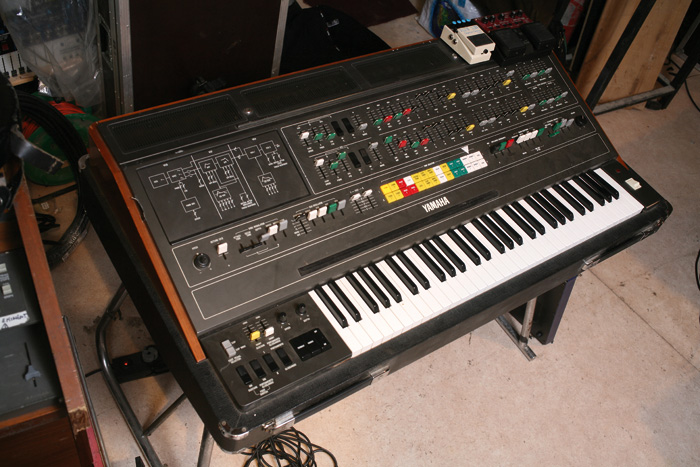
Classic polysynths such as the Memorymoog (top) and Yamaha CS80 were also used in the performance of Oxygene.
EMS VCS3 and Synthi AKS pin-matrix modular synths were central to the recreation of Oxygene; no fewer than five are visible in the pictures of Jarre’s studio. 
Multiple Eminent 310 string machines were central to the Oxygene string sound. Here, a Moog Liberation monosynth is also ready to go.
A Moog Taurus bass synth, stand-mounted for playing by hand rather than foot!


Two Keio Mini Pops drum machines provided an authentically retro rhythm track.